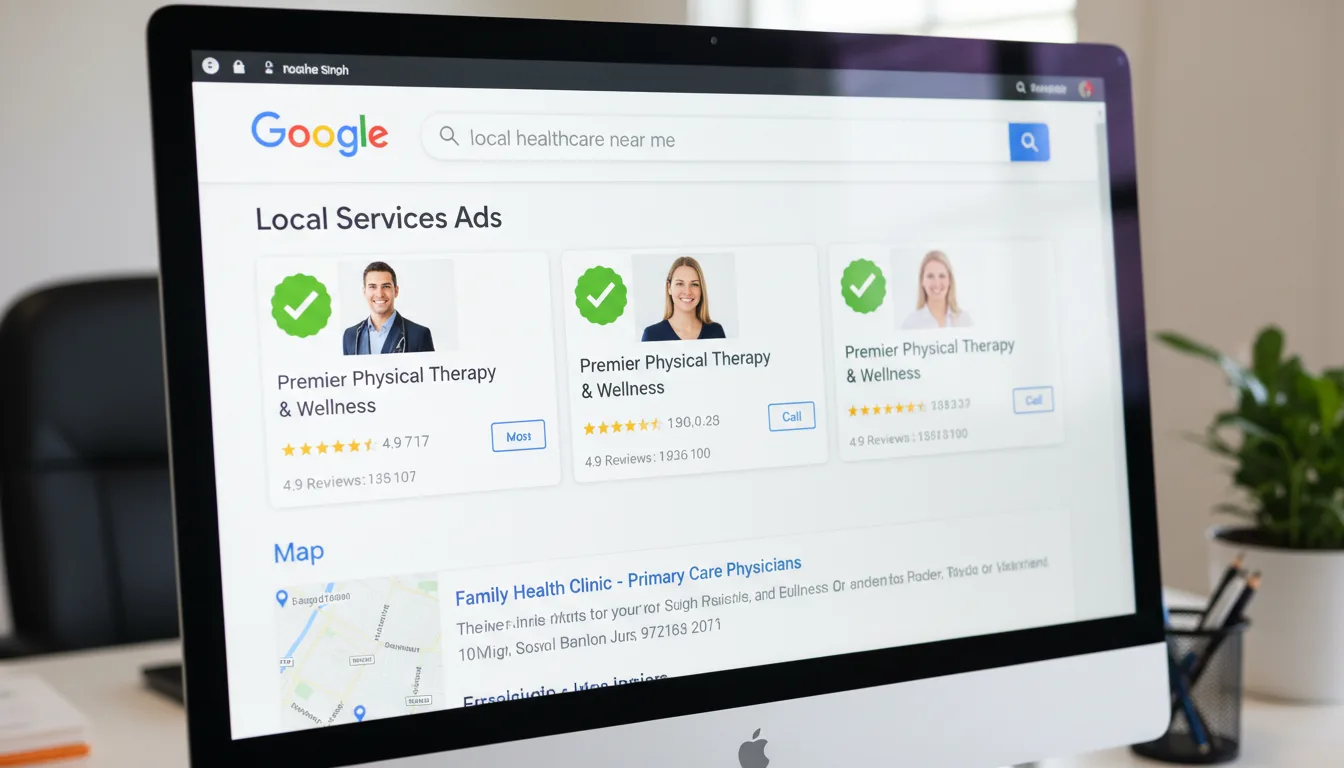
Google Local Services Ads have expanded significantly since their initial launch for home services businesses. In 2026, LSAs are available for dentists, chiropractors, optometrists, dermatologists, acupuncturists, and a growing list of healthcare specialties. The question every practice owner asks is simple: are they worth the money?
The short answer is yes, for most practices, LSAs offer one of the best cost-per-patient ratios in paid healthcare advertising. But the details matter - and the practices that get the most from LSAs are the ones that understand how the platform works and how to optimize it.
How Google Local Services Ads Work
LSAs appear at the very top of Google search results - above traditional Google Ads, above the Map Pack, and above organic results. When a patient searches “dentist near me” or “chiropractor [city],” LSA listings appear first with the provider’s photo, rating, hours, and a “Google Guaranteed” or “Google Screened” badge.
The key differences from traditional Google Ads:
- Pay per lead, not per click. You only pay when a prospective patient calls or messages you through the ad. No charge for impressions, clicks, or window shoppers.
- Google verification. Healthcare providers go through a screening process including license verification and background checks. The resulting badge builds instant trust.
- Limited control. You cannot write custom ad copy or choose specific keywords. Google matches your profile to relevant searches based on your categories, services, and location.
- Budget flexibility. You set a weekly budget and Google spends up to that amount. You can pause and restart at any time.
Real Cost Benchmarks by Healthcare Specialty
LSA costs vary by specialty, market competition, and geographic location. Here are the ranges we see across the practices we manage in 2026:
Dentists
- Cost per lead: $25-$75
- Lead-to-patient conversion rate: 40-60%
- Effective cost per new patient: $50-$150
- Available in: Most US markets
Dental LSAs are highly competitive in metro areas but remain one of the most efficient patient acquisition channels available. The Google Guaranteed badge is particularly valuable for dentists because patients often feel anxious about choosing a new dental provider.
Chiropractors
- Cost per lead: $15-$50
- Lead-to-patient conversion rate: 35-55%
- Effective cost per new patient: $35-$120
- Available in: Most US markets
Chiropractic LSAs tend to cost less per lead than dental because there is less competition on the platform. Chiropractors who list specific conditions they treat (back pain, neck pain, headaches) in their service categories tend to receive higher-quality leads.
Optometrists
- Cost per lead: $20-$60
- Lead-to-patient conversion rate: 45-65%
- Effective cost per new patient: $40-$120
- Available in: Growing number of markets
Optometry LSAs benefit from high search volume (everyone needs eye exams) and relatively low competition. The “Google Screened” badge carries significant weight for a healthcare provider patients are trusting with their vision.
Dermatologists
- Cost per lead: $30-$90
- Lead-to-patient conversion rate: 30-50%
- Effective cost per new patient: $75-$200
- Available in: Select markets (expanding)
Dermatology leads tend to cost more because the specialty commands higher revenue per patient. However, the lifetime value of a dermatology patient often exceeds $3,000, making even a $200 acquisition cost highly profitable.
Other Specialties
LSA availability continues to expand. Physical therapists, acupuncturists, and other healthcare providers should check Google’s current eligible categories regularly, as new specialties are added throughout the year.
The ROI Calculation
The true value of LSAs becomes clear when you compare cost per patient to patient lifetime value:
| Specialty | Avg. CPA via LSAs | Avg. Patient LTV | ROI Multiple |
|---|---|---|---|
| Dentist | $100 | $5,000-$10,000 | 50-100x |
| Chiropractor | $75 | $1,000-$3,000 | 13-40x |
| Optometrist | $80 | $2,000-$5,000 | 25-63x |
| Dermatologist | $150 | $3,000-$8,000 | 20-53x |
Even at the conservative end of these ranges, LSAs deliver substantial returns. The practices that struggle with LSA ROI are typically those with poor phone answering habits or slow follow-up times - problems with their intake process, not with the ads themselves.
How to Maximize Your LSA Performance
1. Answer Every Call
This sounds obvious, but it is the number one reason practices underperform with LSAs. Google tracks your answer rate and responsiveness. Practices that answer calls quickly and consistently receive more leads and better placement. If you miss a call, return it within 15 minutes.
LSA leads are high-intent - these patients are ready to book. If your phone goes to voicemail, they will call the next provider on the list.
2. Accumulate Google Reviews
Your star rating and review count directly impact your LSA visibility and position. Google’s algorithm favors providers with more reviews and higher ratings. Implement a systematic review request process and maintain a rating above 4.5 stars.
3. Set Your Budget Strategically
Start with a moderate weekly budget ($200-$500 depending on your market) and increase it as you confirm positive ROI. Monitor your cost per lead weekly and adjust. In competitive markets, underspending can result in limited visibility. Our Google Local Services Ads management includes ongoing budget optimization based on real performance data.
4. Dispute Invalid Leads
Google allows you to dispute leads that are not legitimate - spam calls, wrong numbers, existing patients, and inquiries for services you do not offer. Disputing invalid leads gets you credited and improves your cost per actual patient. Review your leads weekly and dispute any that do not qualify.
5. Keep Your Profile Updated
Regularly update your business hours, service categories, and service areas. Add any new services as they become available in your profile. Profiles that are current and complete receive preferential treatment in the algorithm.
LSAs vs. Traditional Google Ads
Many practices ask whether they should run LSAs, traditional Google Ads, or both. Here is how they compare:
| Factor | LSAs | Google Ads |
|---|---|---|
| Cost model | Per lead | Per click |
| Avg. cost per patient | $50-$200 | $150-$400 |
| Control over targeting | Low | High |
| Ad copy customization | None | Full |
| Trust signals | Google badge | None built-in |
| Time to results | 1-2 weeks | 1-2 weeks |
| Best for | High-intent local searches | Specific services, broader targeting |
For most healthcare practices, the answer is both. LSAs capture the highest-intent local searches at the lowest cost, while Google Ads provide more control and reach for specific service promotions and geographic targeting. The two channels complement each other rather than compete.
Common Concerns
”I’m not getting enough leads.”
If lead volume is low, check three things: Is your budget sufficient for your market? Are your service categories comprehensive? Is your profile fully complete with photos, services, and hours? Underspending in a competitive market is the most common cause of low volume.
”The lead quality is poor.”
Dispute invalid leads aggressively - this trains Google’s algorithm to send you better matches. Also review your service categories to ensure they accurately reflect what you offer. If you list “cosmetic dentistry” but only want general dentistry leads, you will attract the wrong inquiries.
”My competitors are always above me.”
LSA rankings are influenced by proximity to the searcher, review count and quality, responsiveness, and budget. You cannot control proximity, but you can outperform competitors on reviews and responsiveness. Practices with 100+ reviews and a 4.8+ rating consistently earn top placement.
Is It Worth It?
For the vast majority of healthcare practices, Google Local Services Ads offer the best risk-adjusted return of any paid advertising channel. The pay-per-lead model eliminates wasted spend on clicks that do not convert. The Google badge builds trust that no other ad format can match. And the cost per patient is typically 30-50% lower than traditional PPC.
The practices that benefit most are the ones that commit to answering calls promptly, building reviews consistently, and optimizing their profiles continuously. LSAs reward operational excellence as much as marketing investment.
If your practice is not yet running Local Services Ads, you are likely leaving the most cost-effective patient acquisition channel in healthcare marketing on the table.
Ready to grow your practice? Book a free strategy session or call (888) 616-4494.