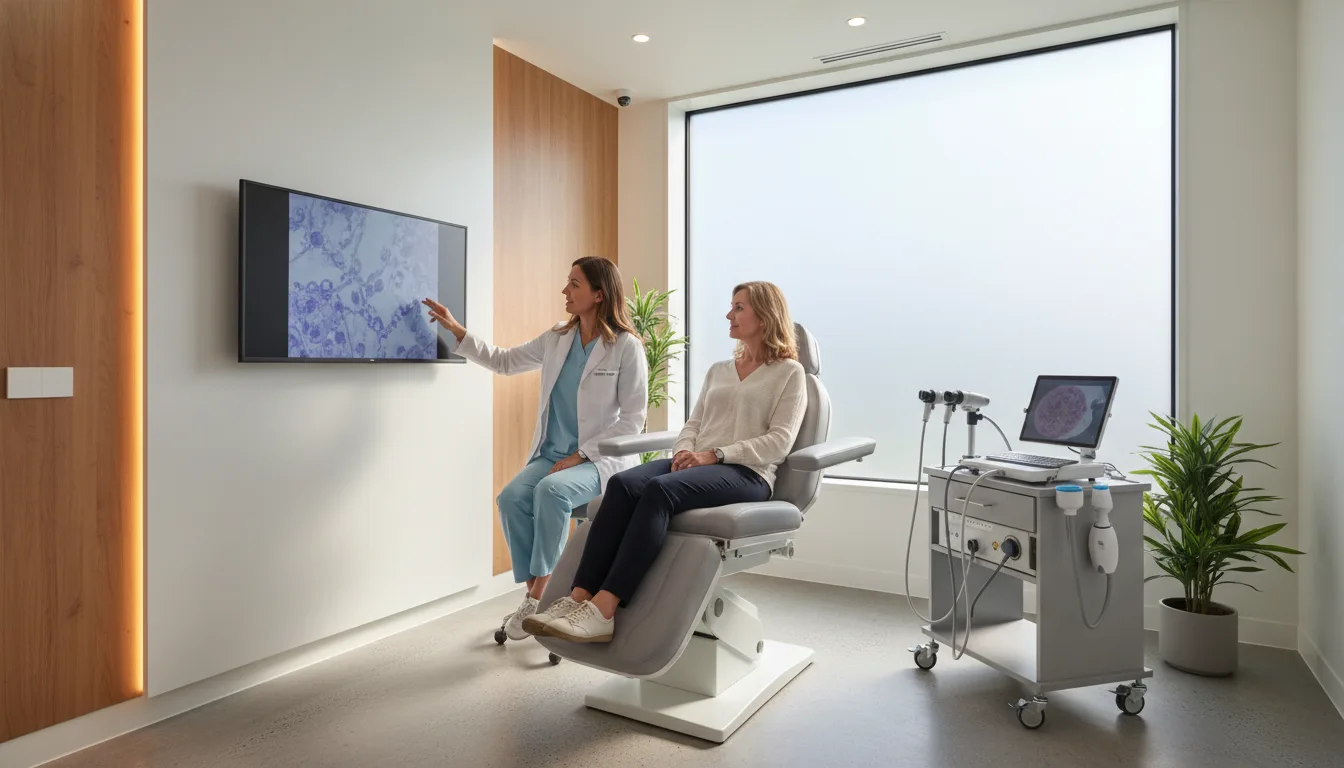
The Dual-Identity Problem: Marketing a Dermatology Practice
Dermatology practices have a marketing challenge that almost no other specialty shares: you are running two businesses under one roof. On one side, you have medical dermatology — acne, eczema, psoriasis, skin cancer screenings, biopsies, Mohs surgery. On the other, you have cosmetic dermatology — Botox, fillers, laser resurfacing, chemical peels, microneedling, body contouring. These two service lines attract fundamentally different patients, require different messaging, operate under different regulatory frameworks, and generate revenue through different mechanisms.
A medical derm patient typically has insurance, arrives with a clinical concern, and needs reassurance about diagnosis and treatment. A cosmetic derm patient is paying out of pocket, arrives with an aesthetic desire, and needs to be inspired and convinced. Marketing to both audiences simultaneously — while maintaining clinical credibility and brand coherence — is extraordinarily difficult. And it is exactly why most dermatology practices are under-marketed relative to their potential.
Why Dermatology Marketing Is Uniquely Complex
The Wait-Time Perception Problem
Dermatology has some of the longest average wait times for new patient appointments in all of medicine — often 4-6 weeks in many markets. This reality creates a paradox: you might think you do not need marketing because your schedule is already full. But a full schedule built on low-reimbursement insurance cases and no cosmetic revenue is not the same as a profitable schedule. Strategic marketing allows you to shape the composition of your patient panel, attract higher-value cases, and reduce your dependence on volume-based medical dermatology.
Medical and Cosmetic Audiences Require Separate Strategies
A patient searching “itchy rash that won’t go away” and a patient searching “best laser treatment for sun damage” could not be more different in their mindset, expectations, and decision process. The first needs clinical information and quick access. The second needs before-and-after evidence, pricing context, and emotional motivation. Treating these as one audience — which is what most agencies do — results in marketing that speaks to neither effectively.
Competition From Both Sides
Medical dermatologists compete with primary care physicians who treat basic skin conditions, as well as teledermatology platforms that offer convenience-first virtual consultations. Cosmetic dermatologists compete with med spas, plastic surgeons, and even nurse injectors operating independently. This two-front competitive pressure demands marketing that clearly articulates what a board-certified dermatologist offers that these alternatives do not — depth of training, diagnostic accuracy, and the ability to provide both medical and cosmetic care in one practice.
Skin Cancer Screening as a Public Health Marketing Opportunity
Skin cancer is the most common form of cancer in the United States, with over 5 million cases diagnosed annually. Yet most adults do not get annual skin checks. This represents both a public health opportunity and a practice-building opportunity. Marketing that educates the public about skin cancer risk and the importance of regular screenings drives medical patient volume while positioning your practice as a trusted health resource in the community.
The Provider Leverage Challenge
Many dermatology practices employ physician assistants and nurse practitioners who handle a significant portion of patient visits. Marketing must build trust in the practice brand, not just the lead dermatologist, so that patients are comfortable seeing any qualified provider. This is a branding nuance that generic agencies consistently miss.
Generic Agencies Cannot Handle Dermatology’s Complexity
A standard marketing agency will build one website, run one set of Google Ads, and produce one social media feed — all blending medical and cosmetic messaging into an incoherent muddle. The medical content will be too clinical to inspire cosmetic patients. The cosmetic content will be too promotional to build clinical trust. And the SEO strategy will target a handful of generic terms while ignoring the hundreds of condition-specific and treatment-specific searches that represent real patient intent.
Even worse, many agencies do not understand the regulatory differences between marketing medical services (which must be evidence-based and clinically accurate) and cosmetic services (which have more creative latitude but still face FTC and state medical board constraints). One misstep in either direction can damage your reputation or trigger a compliance issue.
How ClinicPromoter Serves Dermatology Practices
Dual-Track SEO for Medical and Cosmetic
Our SEO strategy builds two parallel keyword architectures — one for medical conditions and one for cosmetic treatments. On the medical side, we target condition-specific searches like “seborrheic dermatitis treatment,” “mole that changed color,” and “eczema specialist near me.” On the cosmetic side, we target treatment-intent searches like “fraxel laser before and after,” “how much does microneedling cost,” and “dermatologist for acne scars.” Each track has its own landing pages, content strategy, and conversion optimization. Our full SEO methodology ensures both tracks work together to build domain authority.
Patient Reactivation Across Both Service Lines
Our reactivation campaigns for dermatology are uniquely powerful because they can cross-sell between service lines. A medical patient who came in for eczema may be an excellent candidate for a cosmetic consultation. A cosmetic patient who received laser treatment should be reminded about annual skin cancer screenings. We segment your patient database and deploy targeted campaigns that reactivate lapsed patients and expand their engagement with your practice.
Websites With Distinct Patient Journeys
Our website designs for dermatology practices create clearly separated but visually cohesive experiences for medical and cosmetic patients. A visitor with a skin concern finds clinical information, insurance details, and a path to scheduling a medical appointment. A visitor interested in cosmetic treatments finds before-and-after galleries, treatment comparisons, pricing transparency, and a consultation booking flow. Both journeys reinforce the same brand — your dermatology practice — but speak to each audience in their own language.
Content Marketing That Builds Authority on Two Fronts
Our blog program produces content across the full dermatologic spectrum. Medical articles cover conditions, treatments, and prevention strategies. Cosmetic articles explain procedures, manage expectations, and address common concerns. Seasonal content — UV protection guides in summer, dry skin solutions in winter, “new year new skin” campaigns in January — keeps your content fresh and relevant. Every article is reviewed for clinical accuracy and optimized for search performance.
Google LSA for Immediate Patient Capture
Google Local Services Ads are particularly effective for dermatology because patients with skin concerns often want to be seen quickly. Our LSA management puts your practice at the top of search results with a trust-building verified badge. We optimize your categories to capture both medical and cosmetic searches, and we monitor lead quality to ensure you are receiving genuine patient inquiries.
Social Media That Showcases Results Without Compliance Risk
Dermatology is inherently visual, making social media a natural fit — but also a compliance risk if handled carelessly. Our social media strategy creates engaging content that highlights treatment results, educates patients about skin health, and builds your brand’s personality, all while adhering to advertising regulations and patient consent requirements. We produce content formats that perform well on Instagram, TikTok, and Facebook without crossing ethical boundaries.
Newsletter Campaigns That Drive Cosmetic Bookings
Our newsletter service is a particularly effective channel for promoting cosmetic services to your existing medical patient base. Each newsletter includes a blend of skin health education and cosmetic treatment spotlights, positioning cosmetic services as a natural extension of comprehensive skin care. Practices using our newsletters consistently report increased cosmetic consultation requests from existing medical patients.
Essential Dermatology Marketing Metrics
- The average cosmetic dermatology patient spends $2,000-$4,000 annually on treatments
- Dermatology practices that actively market skin cancer screenings see a 25-35% increase in new medical patient volume
- Cross-selling cosmetic services to existing medical patients converts at 3-5x the rate of cold acquisition
- Practices with robust before-and-after galleries on their websites convert cosmetic inquiries at double the rate of those without
- Organic search drives 45-55% of new dermatology patient inquiries in most markets
Stop Leaving Revenue on the Table
Most dermatology practices are operating at a fraction of their revenue potential because their marketing does not reflect the full scope of what they offer. ClinicPromoter builds integrated marketing systems that grow both sides of your practice — filling your medical schedule with the right mix of cases and building a thriving cosmetic service line that transforms your profitability.
Book a free strategy session to see how a dermatology-specific marketing approach can reshape your practice’s growth trajectory.